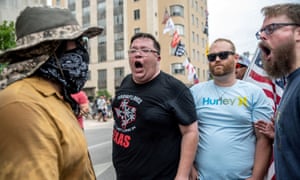
A protest against mask mandates in Austin at the weekend. In Texas, mask-wearing has turned into a partisan squabble.
Photograph: Sergio Flores/Reuters
The
driver license mega center in Fort Worth closed abruptly, just minutes
before 1pm on Tuesday. Staff removed the two tables outside the entrance
that recorded all visitors’ contact information, health histories and
performed temperature checks.
Since reopening on 3 June, the facility had spaced seats inside to
meet social distancing guidelines, cleaned surfaces regularly and only
served those who booked appointments online. All workers wore masks, and
anybody allowed in was required to wear a face covering. But despite
the precautions, a Covid-19 case had been reported there.
One of the people turned away was Laurie Smith, 50. She is an
administrative employee at a local church, where she is also a member,
and calls mandatory mask requirements a sign of “sad” government
manipulation. “My college-age kids are able to follow the
recommendations without questioning it, but my husband and I are of a
different generation, and we value our liberty to be able to make our
own choices. So we question it more than they do,” she said.
Her daughter shook her head silently in the passenger seat but did not say anything. Neither of them wore a mask.
The science of wearing masks to prevent the spread of coronavirus seems to be largely settled,
but the politics around it is still raging, especially in conservative
strongholds like Texas. Stores, churches, small businesses, government
offices and other institutions across the state are grappling with how
to enforce public health rules without alienating those who disagree.
5:28
From miracle cures to slowing testing: how Trump has defied science on coronavirus – video explainer
Mask-wearingsoon turned into a partisan squabble
between lovers of liberty who hate government mandates and supporters
worried about getting sick or infecting others. The consequences of the
deep divisions are starting to appear as coronavirus cases surge in Texas, but a mask remains a public health, political and religious statement.
Covid-19 hospitalizations across the state have more than tripled since the beginning of the month, and hit an all-time daily record of 8,076 cases on Wednesday, according to the state health department. Greg Abbott has pleaded with citizens to wear masks and finally issued an order requiring them Thursday, effective on Friday.
A masked bartender in Austin serves a drink last week.
Bars have again been ordered to close as Covid-19 cases rise.
Photograph: Sergio Flores/AFP/Getty Images
Meanwhile, a patchwork of local regulations, loosely enforced, have sprung up. Prior to the governor’s order, nine mayors unsuccessfully petitioned for power to make masks compulsory, and the governor’s own health commissioner recommended masks.
Dr John Hellerstedt said: “This is the biggest Covid-19 challenge that
Texas has faced since coronavirus hit our state. Every single Texan must
be part of the solution and must join in the battle to reserve these
trends.”
The vacuum left between the two sides is becoming a tinderbox.
“We don’t live in a communist country! This is supposed to be
America,” said Tee Allen Parker, who has banned wearing of masks at her
bar.
The 45-year-old owner of the Machine Shed Bar & Grill in Kilgore, east Texas, has become the face of the resistance fightingmask-wearing among the business community in the state.
She said: “It’s an individual choice. There’s been nothing scientific that says masks are effective.I choose not to wear it, but I don’t let thousands of people breathe on me.”
Parker is leading 22 bar owners and Texans who have sued the governor for closing bars again
last week after a new surge in Covid-19 cases. She points out that
Abbott met the family of George Floyd without wearing a mask.
She said: “There’s a picture of the governor sitting with his family
with no mask on. You can’t tell me to do something you won’t do. You
lead by example.”
Nowhere is the schism as wide as in churches, in a state where 88% of adults say they believe in God
and 63% pray daily. The root of the distrust of official directives
among some Christian conservatives stems from government decisions at
the height of the pandemic.
“Churches were closed by government order, and it makes many
Christians nervous, as it should. I didn’t like it, but I support it,”
said Austin-based Jon Stokes, who co-created the technology news site Ars Technica. He has noticeda fear of government involvement in the church within Christian circles, and wearing masks has become the symbol of it.
A general view of the U.S. Supreme Court on June 30, 2020 in Washington, DC. Stefani Reynolds—Getty Images By MARK SHERMAN / AP July 2, 2020 11:45 AM EDT (WASHINGTON) — The Supreme Court is denying Congress access to secret grand jury testimony from special counsel Robert Mueller’s Russia investigation through the November election. The justices agreed on Thursday to hear the Trump administration’s appeal of a lower court order for the material to be turned over to the Democratic-controlled House of Representatives. The high court’s action will keep the documents out of congressional hands at least until the case is resolved, which is not likely to happen before 2021. Arguments t...
Michael Tracy inside the restored Treviño-Uribe Rancho in San Ygnacio, Texas. Photograph: Bryan Schutmaat/The New York Times/eyevine D iana Uribe points to the door of a stone outhouse beside the old Spanish fort at San Ygnacio, Texas, built in 1830. “My great-great-great-great-great-grandfather and his bride lived there,” she says. In those days, Mexico was trying to stop US immigration here into Tejas – as Texas was then called – to no avail. A slope leads from the street outside down to the slow-rolling Rio Grande, across which you could throw a baseball into the foliage and palms of what is now Tamaulipas, Mexico. It’s a lazy day in San Ygnacio, population 700: grackles swooping and sun beating down on the empty plaza where Marlon Brando once filmed a scene for Viva Zapata; little else. But through here, according to a “national emergency” Donald Trump has declared, a new border wall must cut. Uribe – now 63, a retired teacher – grew up in this ...
(SACRAMENTO, Calif.) — Heading into Memorial Day weekend, California’s mood was celebratory. The state had avoided dire predictions of a coronavirus surge, hospitalizations were starting to decline and restaurants and most other businesses had reopened. As July 4th approaches, the mood has soured. Infection rates and hospitalizations are rising fast. Most bars have been ordered closed along with inside dining at restaurants. Many beaches are off-limits or have restrictions to limit crowds. Fireworks shows are canceled and Gov. Gavin Newsom is imploring residents to avoid the holiday tradition of backyard barbecues and other gatherings of relatives and friends. In about five weeks, the nation’s most populous state went from success story to cautionary tale. Health experts say no single thing went wrong, but contributing factors included a populace made...


Comments
Post a Comment