To build the wall, or not to build? On the Texas border, residents take sides
Get link
Facebook
X
Pinterest
Email
Other Apps
Michael Tracy inside the restored Treviño-Uribe Rancho in San Ygnacio, Texas.
Photograph: Bryan Schutmaat/The New York Times/eyevine
Diana
Uribe points to the door of a stone outhouse beside the old Spanish
fort at San Ygnacio, Texas, built in 1830. “My
great-great-great-great-great-grandfather and his bride lived there,”
she says. In those days, Mexico was trying to stop US immigration here into Tejas – as Texas was then called – to no avail.
A slope leads from the street outside down to the slow-rolling Rio
Grande, across which you could throw a baseball into the foliage and
palms of what is now Tamaulipas, Mexico.
It’s a lazy day in San Ygnacio, population 700: grackles swooping and
sun beating down on the empty plaza where Marlon Brando once filmed a
scene for Viva Zapata; little else. But through here, according to a
“national emergency” Donald Trump has declared, a new border wall must
cut.
Uribe – now 63, a retired teacher – grew up in this village, as did
her forebears, watching names change and borders drawn: granted land in
New Spain under royal charter from Madrid, then Mexico, then the Texas Republic, then the USA after 1848.
“This place isn’t as sleepy as it looks,” says Uribe. “It’s on a
direct highway, if you know the land – which the smugglers do.” Yet even
so: “I don’t feel unsafe here. The last thing they want is to draw
attention to themselves on the border. We just don’t need a wall. Do we
want security? Yes. Do we want or need a wall? No.”
But even that is not the point. Uribe explains how the man who built
this fort, Don Jesús Treviño, had three daughters, one of whom married
Blas María Uribe, from the town of Guerrero across the river in Mexico.
Diana is of that line, “and I am being told I have to be cut off from my
family and people on the other side of a frontier drawn since they
arrived.
“We used to go to Mexico for weddings, dances,” she says, “and
clubbing in Nuevo Laredo, though my parents didn’t know that bit. The
wall cuts across all those generations and traditions. And also through
the realities of border economics, the complete inter-dependency of twin
communities all along the Rio Grande.”
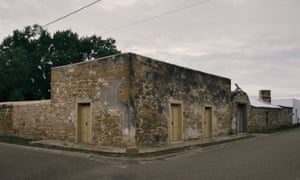
Outside the Treviño-Uribe Rancho, a 19th-century Spanish
fort complex in the sleepy Texas border town of San Ygnacio, Texas.
Photograph: Bryan Schutmaat/The New York Times/eyevine
The fort in San Ygnacio had been entered on America’s National
Register of Historic Buildings in 1973, but was still a ruin when, five
years later, the celebrated artist Michael Tracy moved here,
incrementally, bought it and undertook its restoration.
Sitting in his cactus and agave garden, Tracy recalls how the fort
was actually built to defend against Comanche Indians “by those
trespassing on Native American land. To be honest, though I have done
all this to bring a fortress back to former glory, I think you must
either identify being inside the wall or outside the wall. I am outside
the wall.”
The president’s wall “is mythic”, says Tracy, “it’s meaningless. Yes,
there’s always the possibility here that someone could come to your
door at four in the morning and demand all you have. But will Trump’s
wall stop them? Of course not – it’s a distraction, a perfect way to
mobilise his base thousands of miles from the border.”
“It’s always been no-man’s-land here,” says Uribe. “Too far for the
Mexicans to control, and Washington didn’t want it.” Communities along
this stretch of river are tired of being pawns in distant games.
Residents of the seat of this county, Zapata, and Guerrero over the
border, were in 1953 forcibly moved entirely to accommodate flooding for
a reservoir under the Falcon dam project.
Now Trump’s wall “is like someone in Minnesota telling us on the
tropical river how to do hurricane evacuation”, adds Christopher Rincón,
CEO of the River Pierce Foundation which nurtures local artists, but
for which the Treviño fort restoration has become a raison d’être. “Do
you feel unsafe here, like you need a wall between us and the far bank?”
asks Rincón. “We don’t.” Not all in San Ygnacio share these views, least of all one of Tracy’s main patrons from Los Corralitos ranch across the highway, Lannie Mecom.
A fountain at the heart of Houston’s museum district bears the Mecom
family name, one of Texas’s oil dynasties. Lannie’s grandfather Harvey
bought this ranch in 1913 just after the Mexican Revolution and her
brother owned the New Orleans Saints football team. Now Lannie stands on
the riverbank, after a morning loading longhorn cattle for sale at
market: “That’s Mexico,” she points, 200 metres away.
“I’m happy to donate this land to the government to build a wall,”
pledges Mecom, an energetic 75-year-old. “It’s gotten worse and worse
over there – we had the Zetas [drug cartel] camp right there over the
river, and there was something going on – their cars parked along the
highway here, something mighty scary.”
Mecom, too, owns land on which a historic fort is built, “and it was
built for a good reason”, she half-jokes, “to keep trouble out!”
Her ranching neighbour, Joe Braman, joins us – a canine unit police
officer in Victoria county to the north. “We need a solid wall bad, and
I’d give my land for it right now,” he says. “There’s so many people
coming through here – I’ve caught 284 while training police dogs in the
last few months.”.
We settle back at Los Corralitos ranch – complete with airstrip and
plans for a game-hunting reserve – to sit below a score or more of
deer-head trophies; “most of age, some young”, explains Mecom, “the
grandchildren get buck-fever, you know, look through the scope and wow!”
But also there are Mexican fabrics and colours; Mecom’s view is not an
echo of the president’s, or Braman’s.
“We need to give security to illegal Mexicans who are here already –
been here 20 years, they’re good workers; our neighbours, and poor.
There’s a lot of good people getting hurt; my family never asked people
coming to work here for papers, and I never will. We need to help them
get their papers, pay taxes and contribute to our economy. Yep, help us
make money – but also build that wall.”
Down by the river, the vaquero buying Mecom’s longhorns, Lalo González – riding with skill in his cowboy hat – isn’t so sure.
“I watch who comes and goes,” he says. “The bad guys’ll get through
whatever you build; it’s the honest people that’ll get stopped.”
A general view of the U.S. Supreme Court on June 30, 2020 in Washington, DC. Stefani Reynolds—Getty Images By MARK SHERMAN / AP July 2, 2020 11:45 AM EDT (WASHINGTON) — The Supreme Court is denying Congress access to secret grand jury testimony from special counsel Robert Mueller’s Russia investigation through the November election. The justices agreed on Thursday to hear the Trump administration’s appeal of a lower court order for the material to be turned over to the Democratic-controlled House of Representatives. The high court’s action will keep the documents out of congressional hands at least until the case is resolved, which is not likely to happen before 2021. Arguments t...
(SACRAMENTO, Calif.) — Heading into Memorial Day weekend, California’s mood was celebratory. The state had avoided dire predictions of a coronavirus surge, hospitalizations were starting to decline and restaurants and most other businesses had reopened. As July 4th approaches, the mood has soured. Infection rates and hospitalizations are rising fast. Most bars have been ordered closed along with inside dining at restaurants. Many beaches are off-limits or have restrictions to limit crowds. Fireworks shows are canceled and Gov. Gavin Newsom is imploring residents to avoid the holiday tradition of backyard barbecues and other gatherings of relatives and friends. In about five weeks, the nation’s most populous state went from success story to cautionary tale. Health experts say no single thing went wrong, but contributing factors included a populace made...


Comments
Post a Comment