Britain can't protect Hong Kong from China – but it can do right by its people
To think we can sway authoritarian Beijing is fantasy. Instead we must make those who want freedom welcome in the UK
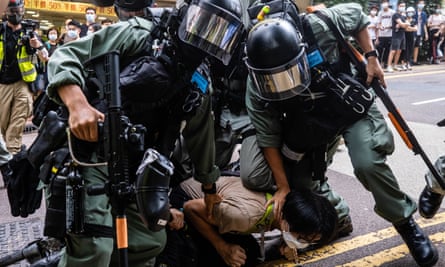
The sight of young people anywhere being brutally stripped of their freedom
is depressing. When that freedom was a legacy, however brief, from the
British crown, it is more so. The ban on dissent now imposed by China on
Hong Kong smashes the spirit and letter of the Sino-British treaty of 1984. It shows China for what it is, an unprincipled dictatorship.
When
I reported in 1997 on the Hong Kong celebrations bidding farewell to
British rule, there was one question on all lips. It was: how long would
Beijing’s 50-year pledge of “one nation, two systems” survive? The
guesses were five years, perhaps 10. China would surely milk the cash
cow for all it was worth, but any sign of trouble and Beijing would
instantly wipe this “imperialist pimple” off the map. No one dreamed
China’s patience would last 23 years.
So it has
proved. The ruthlessness of Beijing’s repression has surprised even
hardened China-watchers. The former governor, Lord Patten, calls it
Orwellian in its reach, not least in criminalising China’s critics
everywhere abroad. A certain tolerance might have better served
Beijing’s image. But every visitor to China knows that what matters to
Beijing is how something looks in Beijing, not abroad. Authoritarianism
validates its own rules.
The bravery of young
Hongkongers in defying the new measures has been impressive. Their
defence of the enclave’s even partial liberties is witness to a rarely
cited legacy of British empire, the embedding of democratic values in
indigenous politics. Back in the benign 1990s, when communist autocracy
seemed in retreat, the idea of former western colonies serving as
advance bases of global democracy seemed just plausible. Britain and
America even fought wars to that end in Afghanistan and Iraq.
This
ambition was fanciful. Hong Kong is part of China, and its attempted
rebirth in 1997 as a liberal cuckoo in Beijing’s communist nest was
absurd. Even the boldest dissident, the young Joshua Wong, gloomily
admitted in his recent book Unfree Speech that he expected it eventually to become just another mainland Chinese city. The only question was when, and how.
Britain is now in a dither over how to react. We can almost hear Beijing’s apparatchiks laugh as London erupts in impotent fury. Perhaps Boris Johnson would care to refight the opium wars. Perhaps he wants to discuss the Yangtze incident. The regime of Xi Jinping
is currently the most disciplined and powerful force on Earth. The idea
of it losing a minute’s sleep over virtue signalling on the far side of
the globe is ridiculous. Yes, Xi tolerated the antics of Wong and his
colleagues for a while. But it was certain that if they went too far,
they would be silenced. Hong Kong’s soberer heads were right: the
radicals should have lived with such freedoms as they were allowed. Now
they have none.
The dull echo of British
empire, shared with Washington, is a craving to tell the rest of the
world how to order its affairs. The walls of the Foreign Office are
lined with images of four continents grovelling at the feet of
Britannia. They seep into the psyche of British foreign ministers, year
after year. This week, politicians of all parties have been dusting off
the rusty weapons of yore. Johnson wants to send his unusable aircraft
carrier to the South China Sea. There is talk of UN resolutions, trade
embargos, “targeted sanctions” and ostracism. The former Tory leader Iain Duncan Smith wants to “show China that it can’t get away with tearing up international treaties and abusing human rights”.
It
can, and it will. The reality is that modern China can do what it
likes, and there is nothing Duncan Smith or anyone in Britain – or
Europe – can do about it. Meanwhile, as Britain buys missiles and
planes, Beijing surges into the 21st century armed with the
weapons of cyberwar and intellectual theft. It hacks systems, throws
switches, corrupts elections and moves vast sums of money round the
world at will. It is out of our league.
The
question of how to handle modern China clearly deserves the most careful
attention. The veteran China-watcher Henry Kissinger has long
contrasted the certainty of its internal command with the uncertainty,
indeed immaturity, of its global outreach. The most pressing concern of
its rulers is that its neighbours within the Pacific basin should not
threaten its political stability. Hence the eye it keeps on Hong Kong,
and over the horizon on South Korea and Taiwan. Relations between China
and these countries are clearly unstable. But the idea that the west has
any role in such potential conflicts, let alone a responsibility to
police them, is madness.
The way for the west
to promote global democracy remains, as always, by example. Just now, in
states on both sides of the Atlantic, democracy badly needs a spring
clean. As for China, Britain’s strongest suit is its soft power, in
particular the popularity of its schools and colleges to the Chinese
middle class. There are more than 100,000 Chinese students in Britain, many of dubious loyalty to their own regime and therefore now at risk. They need encouraging and protecting from the new laws.
One other debt of empire remains to be paid to Hong Kong, and Johnson was right this week to pay it.
When Britain withdrew from the colony in 1997, it offered many of its
people an overseas British passport, with the possible right of UK
residency. Whatever treachery China may have perpetrated, Britain should
keep its side of the bargain. We could never give Hong Kong democracy.
We can at least give it refuge from democracy’s foes.
• Simon Jenkins is a Guardian columnist


Comments
Post a Comment